
The Short Answer for Buroh Connection
Businesses whose main activity is industrial work of the kinds URA lists for Business 2 are the natural occupiers of Buroh Connection: manufacturing, production, assembly, and repair and servicing among them. Each operation is approved against URA’s Business 2 rules and the conditions JTC set for the Jalan Buroh land.
That gives a broad field. B2 is the zone for general industry, and the list of predominant uses runs from machining and fabrication to the assembly of components and the servicing of equipment and machinery.
Manufacturing, Production and Assembly at Buroh Connection
Manufacturing as general industry heads URA’s list of predominant uses for B2. A precision engineering workshop with CNC machines, a fabrication shop or a plant making components falls into this group.
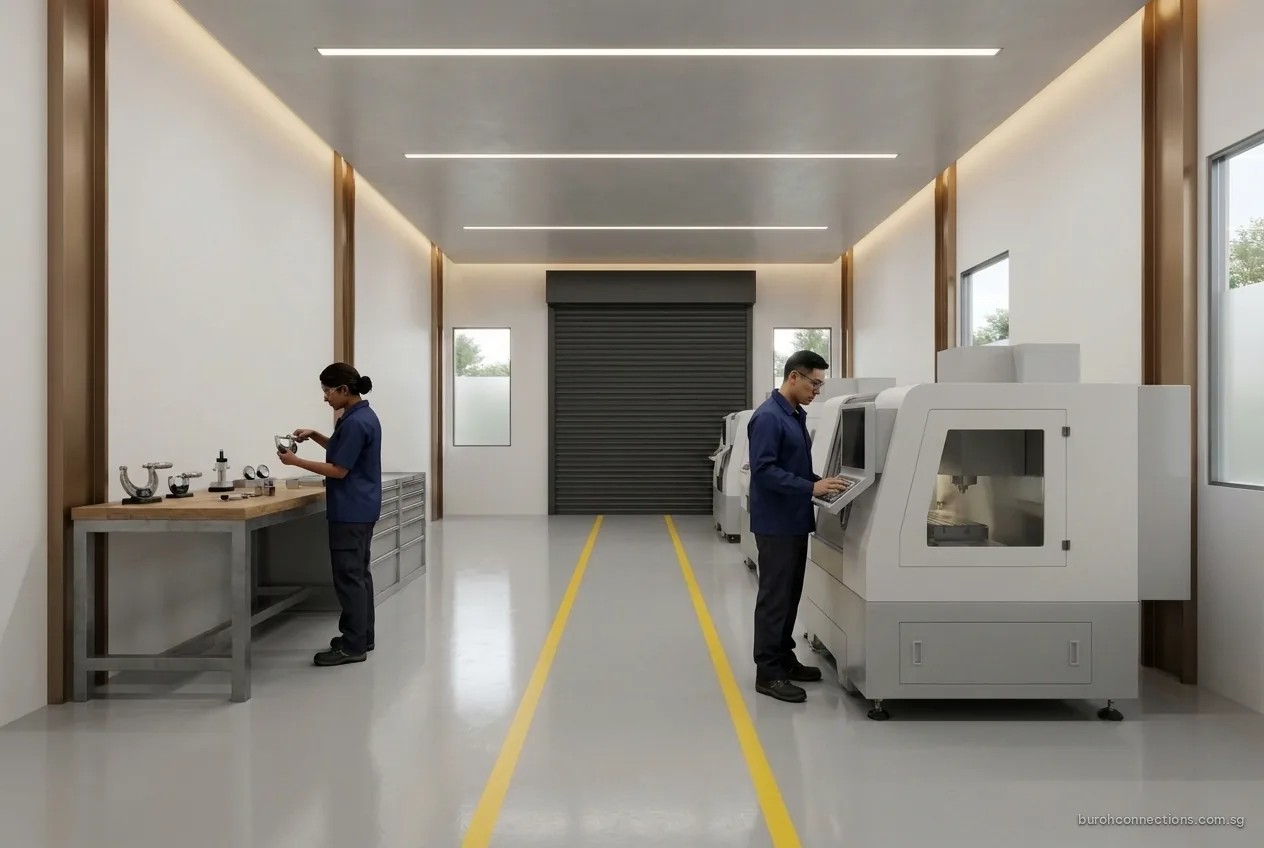
Production and assembly sit alongside it. An electronics firm assembling boards and devices, or a company putting together equipment from parts made elsewhere, is carrying on assembly, one of the named B2 uses.
The pictures in this post are illustrative fit-outs, showing how a unit might be laid out for each trade; the people in them are illustrative staff.
Repair, Servicing and Warehousing at Buroh Connection
Repair and servicing is a predominant B2 use in its own right, which covers workshops that maintain machinery or equipment.
Storage is part of the picture as well. URA counts warehouses among the industrial developments allowed on Business 1 and Business 2 land, so a business that holds and dispatches stock can look at B2 space, subject to the usual approvals.
URA’s list also includes industrial training, core media production and e-business activities treated as industrial, such as telecommunications and software development.
Supporting Space Within Each Buroh Connection Unit
Within every strata unit, at least 60% of the floor area is for the industrial activity and up to 40% may serve supporting uses: an ancillary office, a meeting room, a sick room, and the mechanical and electrical services the operation needs.
Showrooms are considered on the first storey through a change-of-use application after the building receives its Temporary Occupation Permit and the operator is known, and an industrial canteen may serve the people who work in the development.
This is why a B2 unit suits companies whose office and operation sit under one roof: the work floor and the management team can share a single address.
Matching a Trade to a Buroh Connection Unit
The first step for any business is to place its main activity in one of URA’s categories. A workshop that machines parts is manufacturing; a company that builds devices from components is assembly; a firm that maintains machinery or equipment is repair and servicing; a business that holds and ships stock is warehousing.
The second step is the unit itself. Within each strata unit at least 60% of the floor area is for that industrial activity, so the work floor has to be large enough for the machines, benches or racking the business runs. The floor plans and specifications, sent first to registered parties, show how each unit type is arranged.
The third step is approval. Each operation is assessed against URA’s guidelines and JTC’s conditions for the Jalan Buroh land, and URA evaluates any use its list does not name on the merits of the case.
Investors and Their Tenants at Buroh Connection
An investor buying a unit to lease out works with the same categories, because the tenant’s business must fit Business 2. The pool of suitable tenants is the industrial occupiers whose work falls within URA’s predominant uses for the zone.
The supporting allowance works the same way for a tenant as for an owner: up to 40% of the unit for an ancillary office, meeting room or similar space, and at least 60% for the industrial activity.
Location matters to tenants too. A unit about 240 m from the Jurong Pier station planned on the Jurong Region Line, and close to Jurong Island and Jurong Port, offers an industrial tenant a short trip for staff and for goods. The guide to buying or renting looks at the decision from the occupier’s side.
Supporting Uses Shared Across Buroh Connection
Some supporting uses serve the whole development rather than a single unit. URA allows an industrial canteen in a B2 development, with food stalls or a cafeteria serving mainly the people who work in the estate, capped at 700 square metres or 5% of the proposed gross floor area, whichever is lower.
Showrooms are considered on the first storey through a change-of-use application, once the building has its Temporary Occupation Permit and the operator is known, and an ancillary display area may show the products of the operation it belongs to. These shared facilities are planned with the development and shown in the e-brochure and site plan.
How an Operation at Buroh Connection Is Approved
Every proposed use is assessed case by case. URA’s guidelines say that uses not named in its list are evaluated on their merits, and JTC attaches its own conditions to the land it sells, so the approval rests on both.
The simplest step is to raise your trade at registration. The Sales Concierge can check it with you before the release, so you know how your business fits Buroh Connection before choosing a unit. The B1 or B2 guide explains the zoning behind all of this, and the project details page sets out the land particulars.
Register With the Buroh Connection Sales Concierge
Questions about Buroh Connection, from the zoning to the release of the floor plans and price list, go to the Sales Concierge, who answers personally by phone, WhatsApp or email. Showflat viewings are arranged by appointment through the Sales Concierge.