
Buroh Connection Is a Business 2 Development
Buroh Connection stands on land zoned Business 2, or B2. URA uses that zone for general and special industry, whereas Business 1 is kept for clean and light industry.The zoning is fixed by the land itself. JTC released the Jalan Buroh parcel as a Business 2 site in its first-half 2026 industrial land sales programme, and every unit in the finished building will carry that zoning for the length of the 33-year lease.
For a buyer, the zone is the first filter. It decides which kinds of work can be carried on in a unit, and therefore which businesses can occupy it, which tenants an investor can lease to and how wide the pool of future buyers will be.
How B1 and B2 Differ, and Where Buroh Connection Sits
URA’s planning rules split industrial land by the impact of the work done on it. Business 1 is for clean and light industries, the kinds of activity that sit comfortably near other uses. Business 2 is for general and special industries, which may involve heavier machinery, more vehicle movement or processes that need more separation.
The difference shows up in the surroundings too. URA notes that NEA requires a 100-metre nuisance buffer between a B2 zone and the area around it, which is one reason B2 land tends to sit within established industrial districts, such as the stretch of Jurong around Jalan Buroh.
That is why a B2 unit is the natural home for businesses whose work goes beyond light industry: the zone is planned for the fuller spread of industrial activity.
The 60:40 Rule Inside Every Buroh Connection Unit
Both business zones share URA’s use-quantum rule. At least 60% of the gross floor area of a development must be used for industrial purposes, and no more than 40% may go to supporting uses.
In a strata-subdivided building such as Buroh Connection, the rule applies twice: once across the whole development and again inside each unit. Every owner keeps at least 60% of the unit for the industrial activity and may use up to 40% for supporting space such as an ancillary office, a meeting room or a sick room.
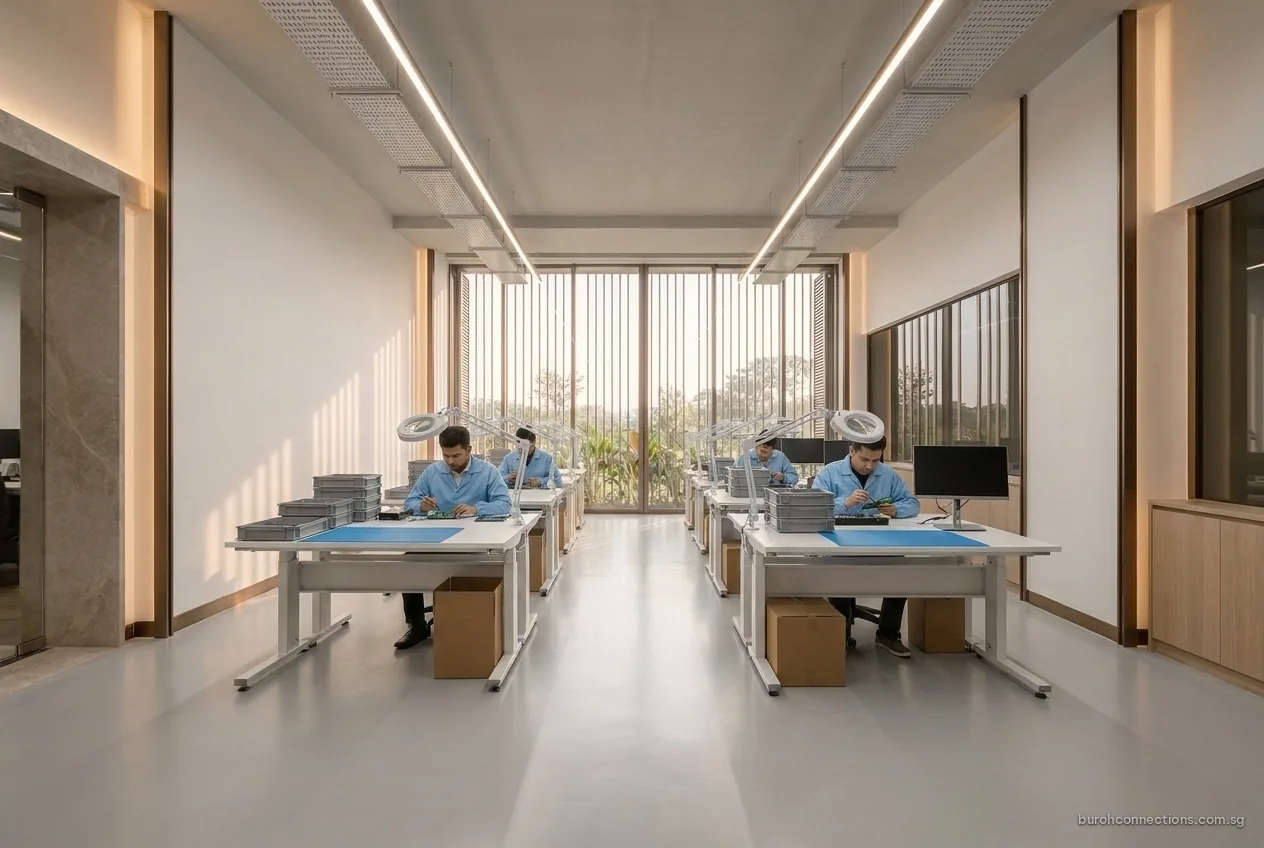
In practice this shapes the layout of a unit. The work floor comes first, with the office and meeting space planned around it within the 40% allowance. When the floor plans are released, they will show how each unit type is arranged.
What Counts as Industrial at Buroh Connection
URA lists the predominant uses for Business 2: manufacturing as general industry, repair and servicing, production, assembly, knitting mills, core media production, industrial training, and the storage of chemicals and oils, together with e-business activities that count as industrial, such as telecommunications and software development.
Supporting uses within the 40% include the ancillary office, meeting rooms, sick rooms and M&E services, with an industrial canteen at development level. Showrooms are considered on the first storey through a change-of-use application once the building has its Temporary Occupation Permit.
Each operation is also assessed against the conditions JTC set for the Jalan Buroh land, so a buyer with a specific trade in mind can have it checked at registration. The guide to the businesses that can operate here takes the categories one at a time.
Where Buroh Connection Sits on the Map of Industrial Land
Business 2 land is grouped within established industrial districts, and the land around Jalan Buroh is one of them. The site lies near the junction of Jalan Buroh and Jurong Pier Road, with the Jurong Island Checkpoint about 590 m away and Jurong Port’s office about 1.1 km away.
That setting suits B2 work. The neighbours are workshops, yards and plants, the roads are built for lorries, and the Ayer Rajah Expressway is reached along Jurong Pier Road. From 2029, LTA expects the Jurong Region Line to stop at Jurong Pier station at the junction, about 240 m away.
A B1 site, by contrast, is more often found where light industry meets other uses. Neither zone is better in itself; the question is which one matches the work a business does. For general industry, B2 is the match.
Buroh Connection and the Multi-User Rules
URA separates single-user industrial developments, which cannot be strata subdivided, from multi-user ones, which can. JTC allows strata subdivision on the Jalan Buroh parcel, so Buroh Connection can be offered as individual strata units, each owned separately.
In a multi-user building, the supporting quantum at development level takes in the common areas outside the units, such as corridors, staircases, lifts, toilets and plant rooms, as well as any secondary uses. Inside each unit, the owner keeps the 60:40 split for its own space.
For a buyer, this means the rules apply to the unit itself, not only to the building. Planning the office, meeting room and pantry within 40% of the unit’s floor area keeps the operation within the zoning from the first day of use.
Why the Buroh Connection Zone Matters When You Buy
For an owner-occupier, the zone answers the basic question of whether the business can run from the unit. For an investor, it sets the pool of industrial tenants the unit can be leased to.
The zone also sits alongside the other fixed facts of the site: a 33-year JTC lease, strata subdivision allowed, and a station planned at the corner on the Jurong Region Line. The project details page brings those together, and the Sales Concierge can talk through any use you have in mind before the release.
Register With the Buroh Connection Sales Concierge
Questions about Buroh Connection, from the zoning to the release of the floor plans and price list, go to the Sales Concierge, who answers personally by phone, WhatsApp or email. Showflat viewings are arranged by appointment through the Sales Concierge.